
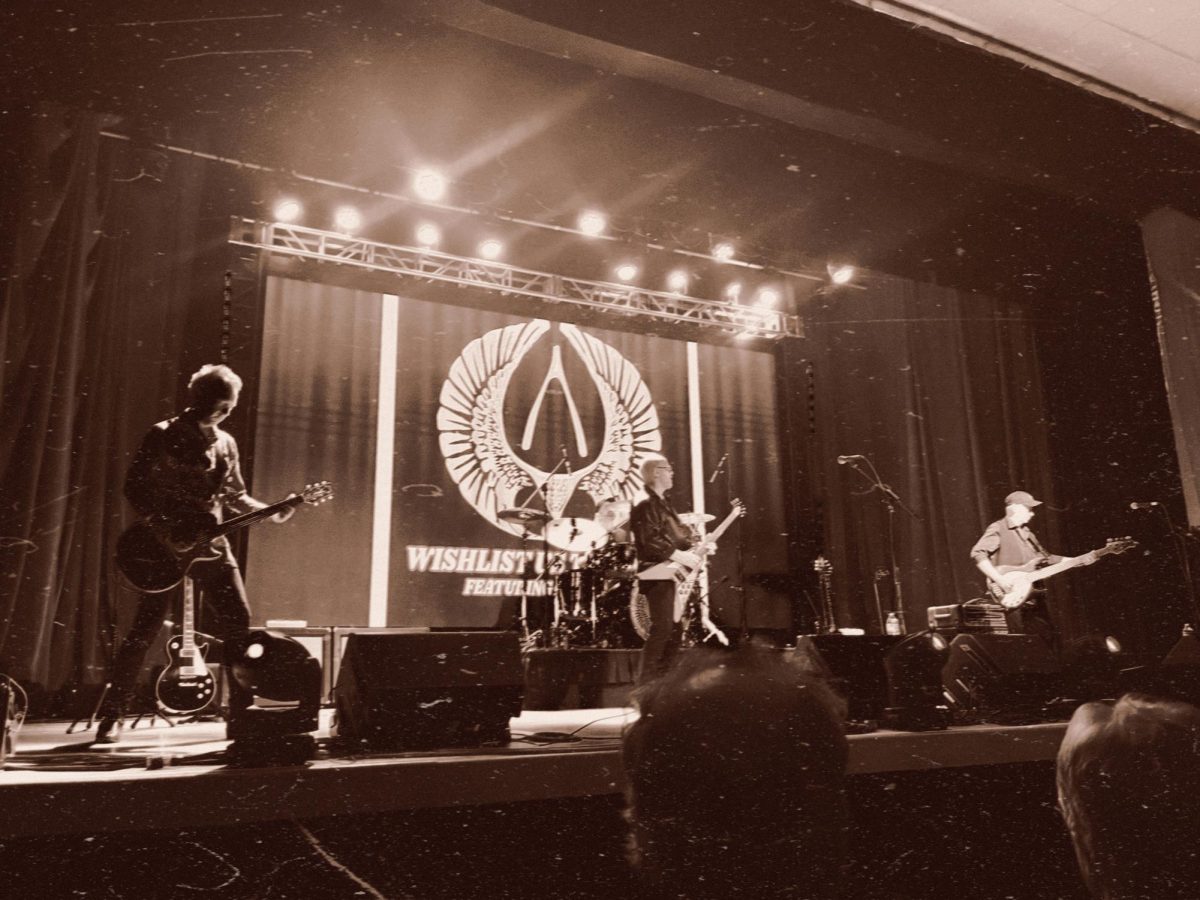
As the sun set on the Kent Stage one night last November, the street lamps lining Main Street emitted a glow resembling that of a Jack-o’-lantern, sharp gold piercing the sky. Looking back, it was sort of the inverse of the sleeve of the record the group in town was commemorating. Wishbone Ash’s Argus, first released in 1972, shows a weird figure in abstract battle garb peering out at a green horizon, its back to the camera, comprehension shielded by helmet and shadow.
The record in full took up the first half of the group’s set, a sprawling pseudo-conceptual odyssey straddling both progressive tendencies and earnest accessibility. Through frontman Andy Powell’s banter in the brief gap between ‘sides’, I learned that while the moodier, more technical second half of the record was composed in the dirge of cloudy London, the first sprang with its breezy brightness from the inspiring, new landscapes they encountered touring the states.
“You know, I think of modern musicians in the way I think of the traveling minstrels of old,” Powell tells me. “It might sound fanciful, but musicians get to travel quickly to all kinds of places and pick up quickly on news, societal trends, politics.” The road turns touring musicians into “mini-philosophers,” as he puts it, as they absorb new environments and experiences.

Of course, Wishbone Ash were certainly not the first notable rock group to grace the Stage specifically. Bo Diddley, Joan Baez, Richie Havens, Todd Rundgren, Richard Thompson, Crystal Gayle, Ace Frehley, multiple Monkees, Al Stewart, Little Feat, and Melanie Safka have all performed there. Its most notable alums are David Crosby, Stephen Stills, and Graham Nash; it was those three, alongside Neil Young, who helped put Kent State on the map with “Ohio”, released barely a month following the shootings on the local campus. Young’s recent show at Blossom a stone’s throw away last year featured a rousing performance of the protest anthem; friends of mine who were able to be in attendance wept.
Thus is the power of music, especially that which holds historical weight, both on the scale of society and the scale of the individual. People across the world have had innumerable life experiences soundtracked to Kent-sprung names like Joe Walsh and Chrissie Hynde, while townies reminisce about local legends such as Glass Harp and Harriet the Spy. Local bars continue to foster college kids kicking around with guitars for fun on school nights, while the student run show Kentcore broadcasts live out of Kent State’s journalism building on Friday nights just down the hall from the radio station room, which is often occupied by a novice host when you stroll by. The pay is meager, but the passion is true.
The kids up north at WCSB, Cleveland State’s station, have been proving that maxim with their fight with the university, which abruptly shut them down in favor of soft jazz and sent them packing with twenty-four hours to spare. It’s very different to the ush-ush of students off campus following the shootings here, but both are shocking and inextricably tied to issues of free speech. Too, they speak to the ability of a community to, in some cases literally, band together, with Kent State students continuing to hold the mantle for May 4, while the gigs by elder punk statesmen the Dead Milkmen in support of the newly-christened XCSB sold out in a blink.
Most students at either institution likely haven’t even heard of Wishbone Ash unless they have the sort of interest in music history that I do, or an older relative hip to such styles. But they’ve been on the road for decades at this point and still record music, with Powell as the sole original member. The synergy on stage at the Stage was magnetic and utterly natural, a quality Powell credits to their distinct sonic blueprint — “twin guitars, dynamic arrangements and good melodic content” — as well as his development as a bandleader — “hopefully a good one, in order to help new band members feel confident and to grow in their roles.”

It is in this ability to welcome new faces while remaining powerfully cohesive that places Wishbone Ash firmly in the British blues tradition spiritually. Of course, the black American genre was co-opted by England’s groups en masse in the late sixties, and lineup changes were more common than not. Think of how many lineup changes it took for Fleetwood Mac to evolve from a scruffy Bluesbreakers spinoff to one of the most commercially successful pop acts of their day; groups like the Stones and the Who (and the Beatles, for that matter) are utterly rare breeds. The sonic stylings of Wishbone Ash have roots in blues rock as well — obvious on songs such as “Jail Bait”, one of the finest of the night — though their ability to branch out, often in unrecognizable ways, is what keeps their work engaging, as it goes with any other larger name from the era. Too, their music is complex in manners more inviting than many of the groups whose names popularly define progressive rock, which says much for a genre that is most often segregated by means of its stereotypes: fantastical stories that can’t be related to, stuck-up noses still runny from glitter inhaled five decades ago.
If the blues are rooted in the timeless art of storytelling, then that is where Wishbone Ash are most faithful to the core purpose of the genre turned transatlantic social phenomenon. Emotion is “what we’re looking for in writing a song,” says Powell. “Connection with the listener… and don’t forget that music is a universal language. Very little translation is needed.” The group have many accents and dialects in their arsenal, and thankfully, they are all delivered as clear as day. Whether they are dealing “Beck’s Bolero” bombast or something softer, almost smoothing, their music is always soundscape-like. Their songs may feature electric guitar that evokes acoustic guitar, or a violin, or clouds, or dreams, or bass lines that resemble an army marching forth, or drums that bring to mind the gallop of a horse, reigns clattering and all.
Powell describes the current existence of Wishbone Ash — making new music while touring the classics — as a process “bringing the past along with us.” In the early years of the group, he says, five years felt like an eternity; now, society has over seventy-five of rock music as we know it to mine. There are always new artists to explore, back catalogues to catch up with, new, green horizons to survey and embark towards. “I have a basic belief in conveying a positive attitude in all that I do and hopefully that helps move things forward — I actually believe it’s a big part of it,” says Powell. “At this point music is my entire life and if I’m not positive about the one thing then it’ll surely affect the other. You only get one life so make the most of it and be positive and engage with like-minded positive people!”
Kent could be more inspiring in one aspect, however — guitarist Mark Abrahams, who wore a striking floral shirt that easily could have been bought at the world’s best thrift store, had strong words to say about the broken coffee machine in his room at the university-owned hotel a block away from the Stage. Thankfully for them and all other groups passing through, the hotel has a remodel on the horizon, which will surely better accommodate artists starving and hefty to come.